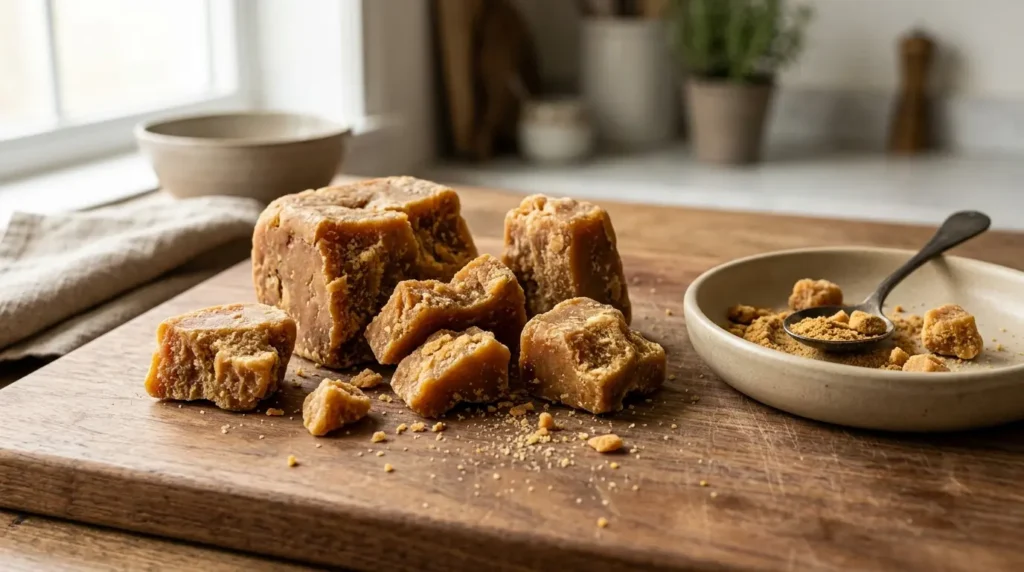
Jaggery shows up under a few different names depending on where you encounter it — jaggery on some packaging, gur on others, sometimes both on the same label. For anyone who hasn’t cooked with it before, that alone can be confusing, before you even get to the different forms and colours it comes in. This guide explains what jaggery actually is, how it’s made, how it compares to refined sugar, and what’s worth knowing before you buy it.
What Is Jaggery?
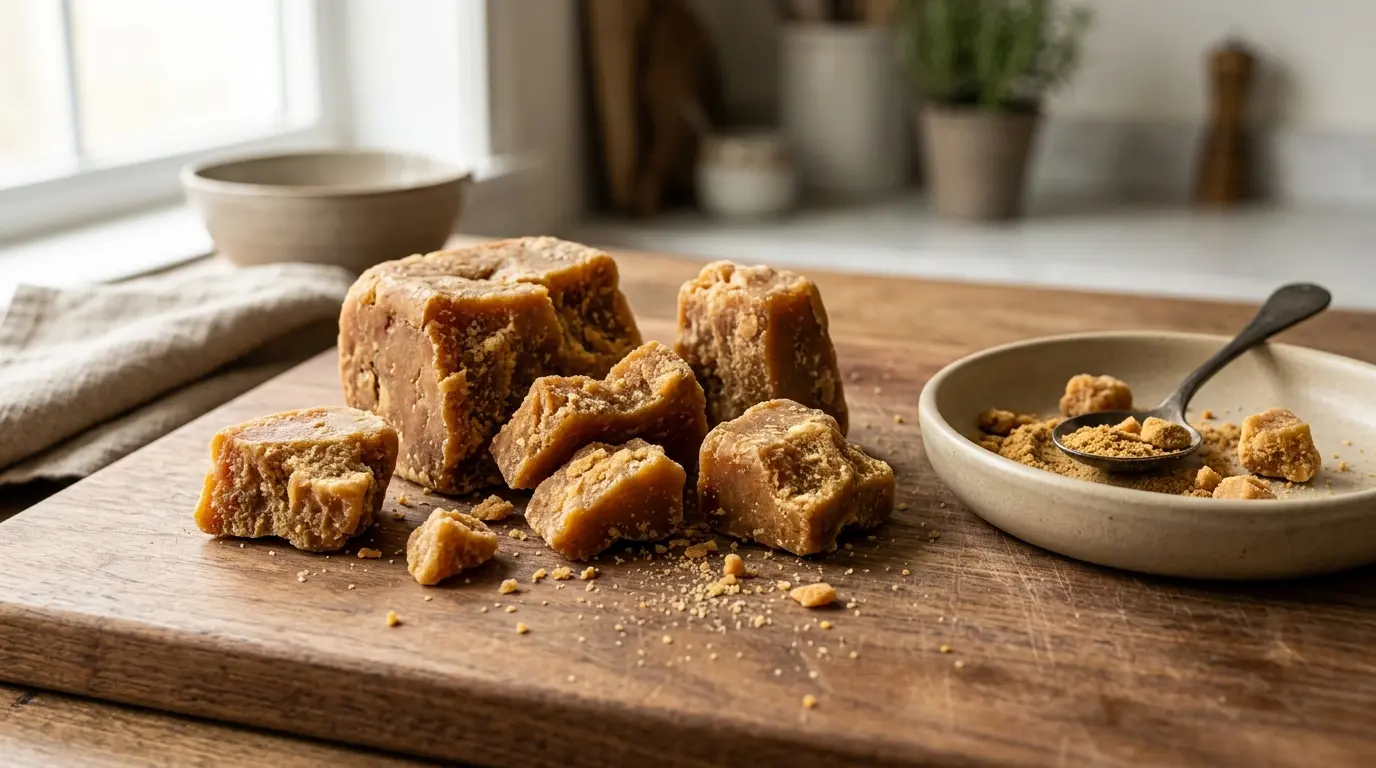
Jaggery is an unrefined sweetener made by boiling and concentrating sugarcane juice (or, in some regions, palm sap) until it thickens and solidifies. Unlike refined white sugar, it isn’t processed to remove molasses, which gives it a darker colour, a denser texture, and a deeper, caramel-like flavour.
It’s sold in several forms — solid blocks, smaller granules, or a thick syrup — depending on how it’s processed and packaged. Regardless of form, the basic idea is the same: cane or palm juice is reduced through heat until it concentrates into a solid or semi-solid sweetener, with far fewer processing steps than refined sugar.
Jaggery and Gur: Is There a Difference?
Not really. “Gur” is simply the Hindi, Punjabi, and Urdu word for jaggery, and it’s the term most commonly used across North India and by South Asian communities more broadly. “Jaggery” is the more general English term, used across South and Southeast Asia and increasingly in Western grocery contexts.
You’ll sometimes see both words on the same package, which isn’t a labelling error — it’s just two names for the same category of product, aimed at different readers. Regional and language differences also affect naming further: in parts of South India, for example, jaggery made from palm sap has its own distinct names separate from cane jaggery. But at the core, gur and jaggery describe the same thing.
How Is Jaggery Made?
The basic process hasn’t changed much over time, even where equipment has modernized. Sugarcane is crushed to extract its juice, which is then filtered to remove plant fibre and other solids. The filtered juice is boiled in large open vessels, and as water evaporates, the liquid gradually thickens into a dense, syrupy concentrate.
Once it reaches the right consistency, the hot liquid is poured into moulds to cool and solidify into blocks, or processed further into smaller granules. The whole process relies on heat and time rather than chemical refining, which is the main reason jaggery retains its molasses content and darker colour, unlike white sugar, which goes through additional steps specifically to strip those elements out.
Cane Jaggery and Palm Jaggery
Most jaggery sold and used in North Indian cooking comes from sugarcane, and this is the type most people picture when they hear the word. It tends to be firmer, ranges from golden brown to deep brown in colour, and has a robust, caramel-forward flavour.
Palm jaggery, more common in parts of South India and Southeast Asia, is made from the sap of certain palm trees rather than sugarcane. It’s often lighter in colour, sometimes softer or crumblier in texture, and has a slightly different, more toffee-like flavour profile. The two aren’t always interchangeable in recipes that call for a specific one, since they behave a little differently when melted or dissolved.
Forms You’ll Find in Stores
Jaggery is sold in a few common forms, and knowing the difference helps when choosing one for a specific use:
- Solid blocks or slabs — the traditional form, usually broken or grated as needed before use.
- Granulated or powdered jaggery — pre-processed into smaller pieces, which dissolves faster and measures more like sugar for everyday cooking.
- Liquid jaggery (jaggery syrup) — a thick, pourable form that skips the need to melt or grate anything, useful where a liquid sweetener is more convenient.
None of these forms is inherently better than the others; the right one usually depends on the recipe and how quickly you need it to dissolve.
How Does Jaggery Differ from Refined Sugar?
The most direct difference comes down to processing. Refined white sugar goes through additional steps that remove molasses and other plant compounds, leaving behind mostly pure sucrose crystals. Jaggery skips those extra steps, which is why it keeps its darker colour, its coarser or denser texture, and its more complex, caramel-like flavour.
That difference in flavour matters in the kitchen. Refined sugar sweetens without adding much taste of its own. Jaggery brings an earthy, slightly smoky sweetness that changes the character of a dish, not just its sweetness level. It also behaves a little differently when heated — it tends to melt into a syrup rather than dissolve as cleanly as granulated sugar, which is worth accounting for in recipes that weren’t originally written for it.
How Is Jaggery Traditionally Used?
Jaggery has a long-standing role in South Asian cooking, both in sweets and in savoury dishes. It’s a core ingredient in traditional sweets like laddoos, chikki, and various milk-based desserts, where its flavour is often the main character rather than a background note.
In savoury cooking, small amounts of jaggery are commonly used to round out a dish — added to dals, sambar, or certain curries to balance sourness or spice rather than to make the dish taste sweet. In some households, a small piece of jaggery is also eaten on its own after a meal, a customary practice in several regional food cultures.
Cooking with Jaggery
A few practical points make working with jaggery easier, especially for anyone used to cooking with refined sugar:
- Grate or break blocks before use. Solid jaggery doesn’t measure or dissolve well in large chunks.
- Melt it gently. Warming jaggery slowly, often with a splash of water or milk, helps it dissolve evenly without scorching.
- Expect a texture difference. Because it’s less refined, jaggery-based syrups can be slightly grainy compared to sugar syrup, which is normal rather than a flaw.
- Adjust to taste rather than a strict substitution ratio, since jaggery’s sweetness and moisture content can vary somewhat between batches and forms.
- Strain if needed. Melted jaggery occasionally contains small bits of sediment from processing, and straining it before use gives a smoother result in delicate recipes.
How to Store Jaggery
Jaggery is sensitive to moisture, which can cause it to soften, become sticky, or in some cases develop mould over time. A few habits help keep it in good condition:
- Store it in an airtight container rather than leaving it exposed to air.
- Keep it in a cool, dry place, away from direct sunlight and humidity.
- Wrap or seal blocks tightly if you’re not using the whole piece at once.
- In warm or humid climates, refrigeration can help extend how long it stays firm, though this isn’t strictly necessary everywhere.
For packaged jaggery, it’s best to follow the storage guidance and best-before date printed on the product rather than relying on general assumptions, since processing and packaging can affect how long it stays fresh.
What to Look for When Buying Jaggery
A few practical checks make it easier to choose a good product:
- Colour and texture appropriate to the type. Cane jaggery is typically golden to dark brown; unusually bright or uniform colour can sometimes signal added colouring rather than a naturally processed product.
- Clean ingredient list. Traditionally, jaggery is made from just cane or palm juice. Checking the label for a short, simple ingredient list is a reasonable way to gauge how minimally it’s been processed.
- Packaging integrity. Since jaggery is sensitive to moisture, torn or poorly sealed packaging is one of the first things worth checking.
- Consistency appropriate to its form. Blocks should be reasonably solid rather than overly soft or sticky in the package; granulated jaggery should look and feel dry rather than clumped.
- A source you trust. As with most pantry staples, dependable sourcing and processing standards tend to show up in how consistently the product performs from batch to batch.
Some natural variation in shade and texture is expected with jaggery, since it’s a minimally processed product rather than a uniform manufactured one.
Jaggery in the Gyan Foods Range
Jaggery is part of Gyan Foods’ broader range of everyday pantry staples, alongside lentils, flours, cooking oils, and more than 400 SKUs and growing. As with the rest of its catalogue, Gyan works with selected producers and trusted manufacturing partners when developing its product range, with attention to consistency and familiar quality from one purchase to the next.
The goal isn’t to reintroduce jaggery to anyone who already knows it, but to make a familiar pantry ingredient easy to find in a form that performs the way it’s expected to, whether it’s headed into a pot of dal or a batch of traditional sweets.
Frequently Asked Questions About Jaggery
Is gur the same as jaggery? Yes. Gur is the Hindi, Punjabi, and Urdu word for jaggery. Both terms refer to the same category of unrefined sweetener.
What is jaggery made from? Jaggery is made from sugarcane juice, or in some regions from palm sap, which is boiled down and concentrated until it solidifies.
How is jaggery different from brown sugar? Brown sugar is typically refined white sugar with molasses added back in during processing. Jaggery is made directly by concentrating cane or palm juice, without going through the refining process that separates and later reintroduces molasses.
Does jaggery dissolve like regular sugar? Not exactly. Jaggery tends to melt into a syrup when heated rather than dissolving as cleanly as granulated sugar, and it can be slightly grainy in texture depending on the form.
What’s the difference between cane jaggery and palm jaggery? Cane jaggery comes from sugarcane and is generally firmer with a robust, caramel-forward flavour. Palm jaggery comes from palm sap, is often lighter and softer, and has a more toffee-like taste.
How should jaggery be stored? In an airtight container, kept cool and dry, away from moisture and direct sunlight. Refrigeration can help in warm or humid climates.
Can jaggery be used in place of sugar in any recipe? It can often be substituted, but not always in a strict one-to-one ratio, since jaggery adds its own flavour and behaves differently when heated. It works best in recipes where its caramel notes complement the dish.
Where can you buy jaggery in Canada? Jaggery is increasingly available through grocery and specialty food retailers across Canada, typically sold as blocks, granules, or syrup.